San Francisco Chronicle
Chronicle Arts and Culture
December 26, 2004CRITICS CHOICES 2004 - Helnwein
Steven Winn
Chosen as the most important show of a contemporary artist in 2004.
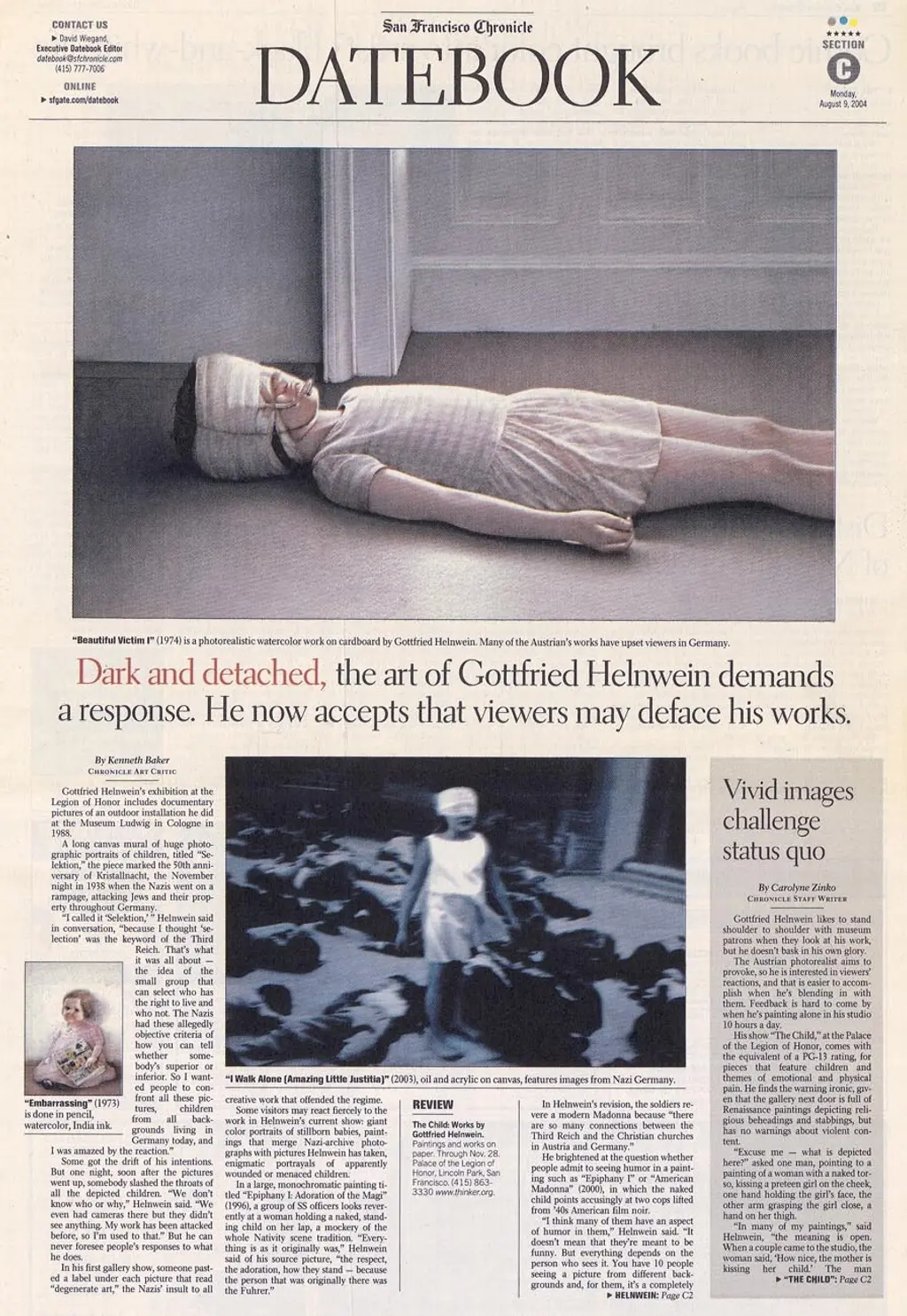
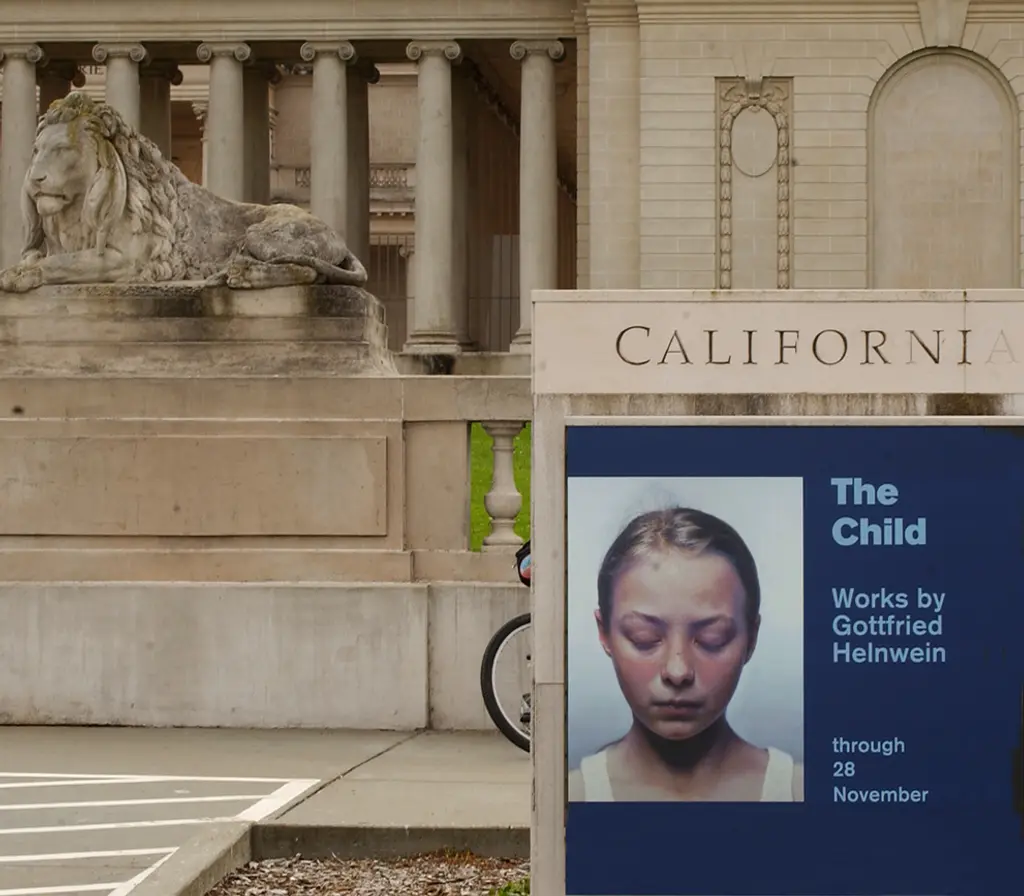
TOP 10 The Gottfried Helnwein exhibition "The Child" at the Palace of the Legion of Honor (San Francisco Fine Arts Museums, July) was chosen as the most important show of a contemporary artist in 2004. "In the first of two shows (the other at the Modernism Gallery in November), Helnwein's large format, photo-realist images of children of various demeanors boldly probed the subconscious. Innocence, sexuality, victimization and haunting self-possession surge and flicker in Helnwein's unnerving work."
San Francisco Chronicle Childhood isn't what it used to be. In the arts, it's dark and complex. Steven Winn Chronicle Arts and Culture
November 17, 2004
Gottfried Helnwein's work is on display at the Legion of Honor and at Modernism Inc. Her lips are parted and colored a luscious deep red. The pancake makeup on her face gives off a marble-white glow. A jacket, adorned with braided gold epaulets at the shoulders, yawns open, exposing a wide expanse of skin down her chest. She appears to be about 8 years old. There was a time, not so long ago, when the subject of Gottfried Helnwein's new, large-format digital prints at San Francisco's Modernism Gallery might have alarmed or even scandalized a viewer. Not anymore -- or at least not so reflexively... Adults bring a trunkful of contradictory cultural baggage to any representations of children. That's what makes the work of Helnwein so powerful. In his show, "The Child," at the Legion of Honor, deformed infants and bandaged children stir feelings of pity, defiance and uneasiness about exploitation. There's an ambiguously disturbing painting of a girl aiming a gun into an open refrigerator and another of a bare-breasted mother and child surrounded by Aryan soldiers. But the most haunting images, here and across town at Modernism, may be the ones of children who seem strangely oblivious to the adult gaze. Some of Helnwein's children peer right past the onlooker. Others sleep, dreaming of anything but us behind their silky eyelids. And some, like the enormous, half- shadowed "Head of a Child" at the Legion, see straight through us with cloudless, infinite blue eyes.
ARTnews
Volume 104/Number 3March 1, 2005REVIEW: Gottfried Helnwein, San Francisco
Kenneth Baker
A highly satisfying survey of his work at the Legion of Honor museum titled "The Child" was dominated by images of children, as was a current exhibition of his more recent work at Modernism.
A collector once told Austrian-born painter Gottfried Helnwein that the child was the true subject of Helnwein’s work. The artist, who now lives in Los Angeles, decided that the agreed. A highly satisfying small survey of his work at the Legion of Honor museum titled “The Child” was dominated by images of children, as was a concurrent exhibition of his more recent work at Modernism.
Helnwein took inspiration for his 1970’s work from the grotesque performances of the Viennese Actionists. Early pieces in the museum show included images in which female children appeared blindfolded, bandaged,. Or with faces trussed in what look like sadistically customized dental or ophthalmologic equipment.
Several early watercolors depicted little girls, difficult to distinguish from dolls, disfigured by facial wounds (perhaps botched surgery). The large monochromatic 1998 oil on canvas Epiphany III (Presentation at the Temple) revealed something of Helnwein’s source material and his methods. It combines an archival documentary photo of a gathering of German World War I veterans with mutilated faces and Helnwein’s own shot of a little girl supine on the table.
After wincing for a while, viewers found themselves admiring Helnwein’s conceptual compositions. The artist knows that images of disfigured Great War veterans provide some of the impetus for early surrealism. He slams those references against an allusion to religious martyrdom, the episode of Jesus’ presentation in the Temple of Solomon, often employed in Christian art to symbolize the contrast between worldly and spiritual splendor, between sin and innocence.
In one respect Epiphany III aligns with very different moments in Helnwein’s work, such as the giant, oddly touching late ‘90s portraits of deformed stillborn infants he titled “Angels” and the recent digital pigment prints at Modernism of a young girl posing in nothing but a military officer’s jacket. Beyond their shock effect, these works assert the pornographic nature of images, or of our response to them, or both in the present situation of culture. Helnwein appears determined to make us uncomfortably aware o fhtis situation by any means necessary.
–Kenneth Baker