Time is running out. She can’t stave off its passage. But, oh, the pangs of loss, the nagging intrusion of reality, and the knowledge that nothing can stay as it is – even the all-consuming swirl of ecstatic oneness with a lover must end.
That, in short, is what Richard Strauss and his librettist, Hugo von Hofmannsthal, wrought in Der Rosenkavalier, their lyric comedy of manners and mores focused on the Princess of Wertenberg, the field marshall’s wife who comes to terms, personally, with all that is ephemeral and thus bittersweet in life – and also reflects the coming social revolution that will displace her and her aristocratic ilk.
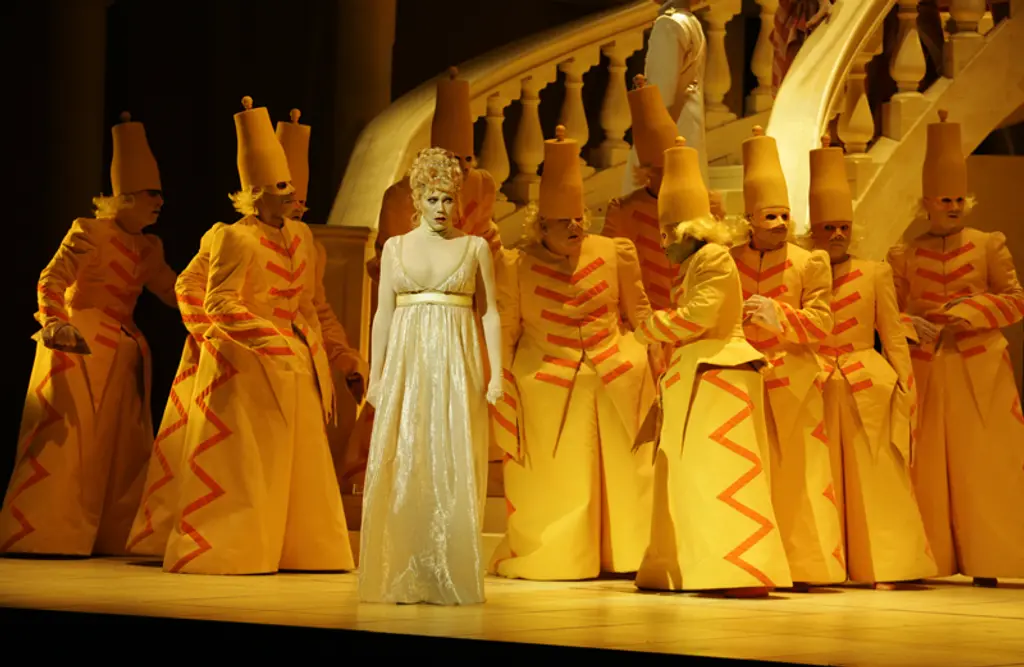
It’s a complicated, brilliantly nuanced piece, and Los Angeles Opera, which 11 years ago borrowed Jonathan Miller’s production from English National Opera, this time snared director Maximilian Schell and artist/designer Gottfried Helnwein for a new, big-budget staging.
The result? Visuals that can overpower the delicate text and even occasionally seem at odds with the glittery, enrapturing music but that nonetheless are strikingly provocative in a museum-installation kind of way. Call the look postmodern Baroque, a kind of cool Fellini-esque phantasmagoria, done as artsy chic and maximized by Alan Burrett’s ingenious lighting. The outer acts have a single-hue, ghostly wash, with one or several of the central characters in blazing color from head to toe as stark contrast. The second act is a peachy gold, no spectral downside.
Yes, it will offend the traditionalists – those who look for straightforward 18th-century effects or a thoughtfully loaded update, as Miller took, to just before World War I. That show guaranteed certain indelible images – such as the opening scene, with the two lovers luxuriating in bed, satin ecru sheets draped around them, a soft light issuing from a side window as in a Vermeer. A great deal more poetic and sensuous than they are here, placed obscurely on a spartan platform bed in a dark corner.
In the third act, Helnwein transfers the libretto’s grubby tavern to his own downtown studio – its walls filled with giant portraits of contemporary girls.
In contrast there is Schell’s direction, alert and sensitive to the libretto’s wealth of pointed associations, teasing innuendos, sighing philosophies, and ambiguous whimsies. By superimposing clips from Hofmannsthal’s 1926 silent film of Rosenkavalier, he brings context, fitfully, to the work.
In the lovers’ boudoir scene, for instance, where Strauss’s score sounds a graphic orgasm via its ripping horn motif, the film gives us parallel action: the field marshall leading his troops to a bloody clash as his wife abandons herself to sexual intimacy with the young Count Octavian. True, the battle versus the bedroom was Hofmannsthal’s afterthought. But Schell wanted to honor that moment of heightened drama.
The cast is excellent – Adrianne Pieczonka as a glinting-voiced Marschallin could break your heart with her inner torments; Alice Coote, a Juliet Stevenson look-alike, has a barely contained passion as the boyish Octavian; the redoubtable Kurt Rydl makes a wily Baron Ochs whose effortless low notes could always be counted on, even though his basso now wobbles elsewhere; and the lovely Elizabeth Futral as Sophie, here made to look wrongly whorish, who sings radiantly but at times sounds less than pure-toned.
Kent Nagano leads the orchestra smartly in this fabulous score that crackles with energy and is alternately glazed with limpid ardor and sustained sensuality. (Though no one, arguably, could shake the memory of Carlos Kleiber, who found vital fluctuation in every tempo, inflection in every phrase – who stretched, probed, and pushed everything as an innate response to the moment’s impulses, defining ecstasy in the gorgeously screeching ritard for the exultant waltzes.)
Our man-of-the-hour maestro also presides expertly over a revival of Falstaff that brings Bryn Terfel to L.A. Opera for this second work featuring an over-the-hill, down-on-his-luck nobleman. And no one around today could be better. The Welsh baritone was probably born to sing Verdi’s besotted fat knight – he has so much robust voice that all manner of subtle colorations come into play. And, rather than the pathetic, mournful “barrel of blubber,” he’s a lovable narcissist – not a silly poseur but a belly-proud, self-confident scoundrel who foists his virility on any unsuspecting woman.
Nagano especially makes the orchestra shimmer in the magical third-act fantasy, though he paces all else so fast that the Nanetta-Fenton love music barely has time to breathe.
Der Rosenkavalier (through June 19) and Falstaff (through June 15), Dorothy Chandler Pavilion, Music Center, 135 N. Grand Ave., L.A. Info/schedule: (213) 972-8001 or Musiccenter.org.