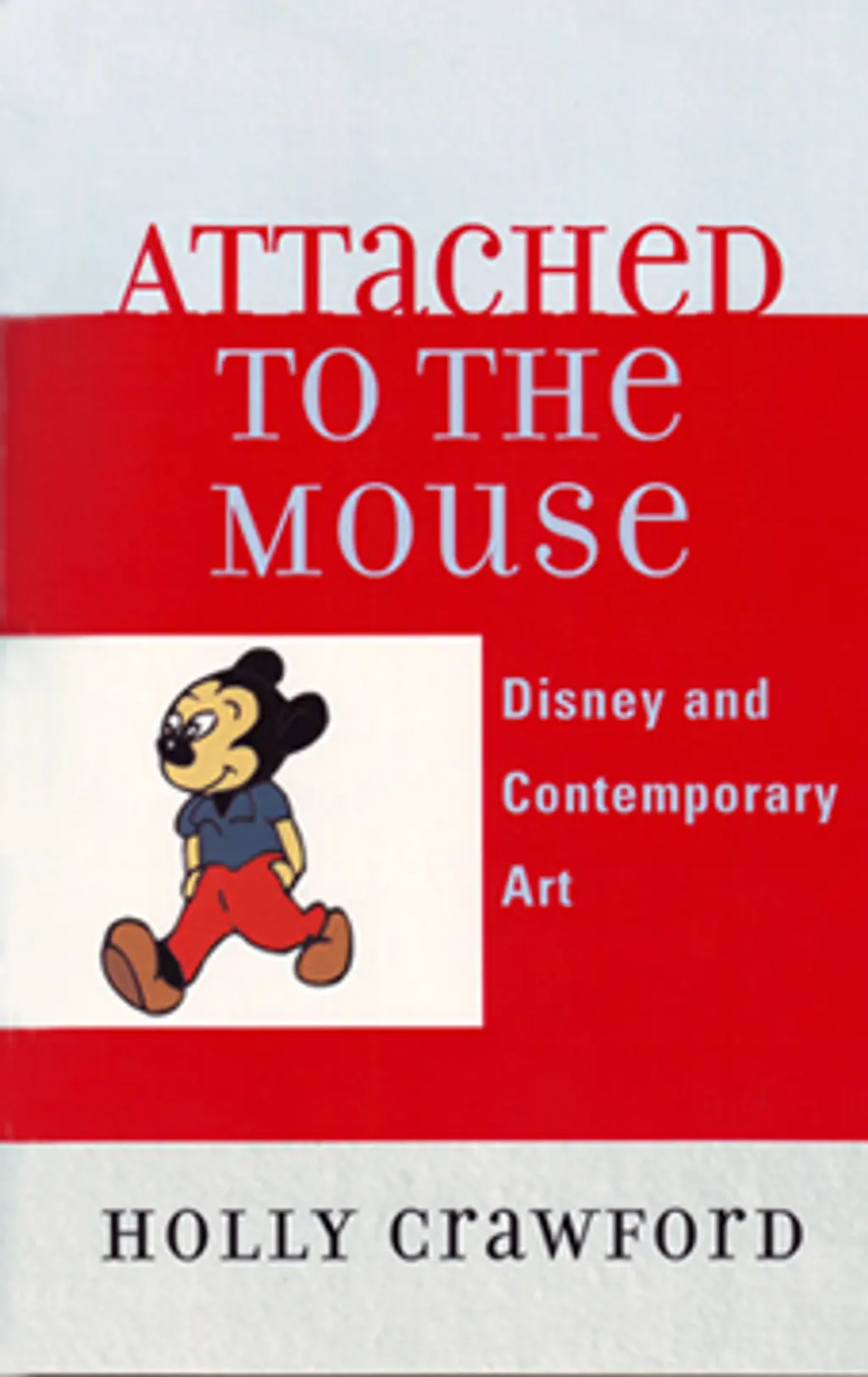
Paperback: 194 pages
Publisher: University Press of America (July 28, 2006)
Language: English
ISBN: 0761834745
Table or Contents
Introduction
Chapter 1: The Mouse: Debut, Copyright and Referenced
Chapter 2: Artists and the Mouse: Humor, Attachment, and the Gambit
Chapter 3: It All Started With a Mouse
Chapter 4:Nostalgia Mouse
Chapter 5: Next Stop Main Street Disneyland
Chapter 6: Love and Hate
Chapter 7: Portrait and the Mickeyfied
Chapter 8:Grim(m) Mouse
Chapter 9: Conclusions
HUMOR
[Chapter 2, Artists and the Mouse: Humor, Attachment and the Gambit, pages 8-13]
Chapter Two
Artists and the Mouse: Humor, Attachment and the Gambit
Excerpts from the book:
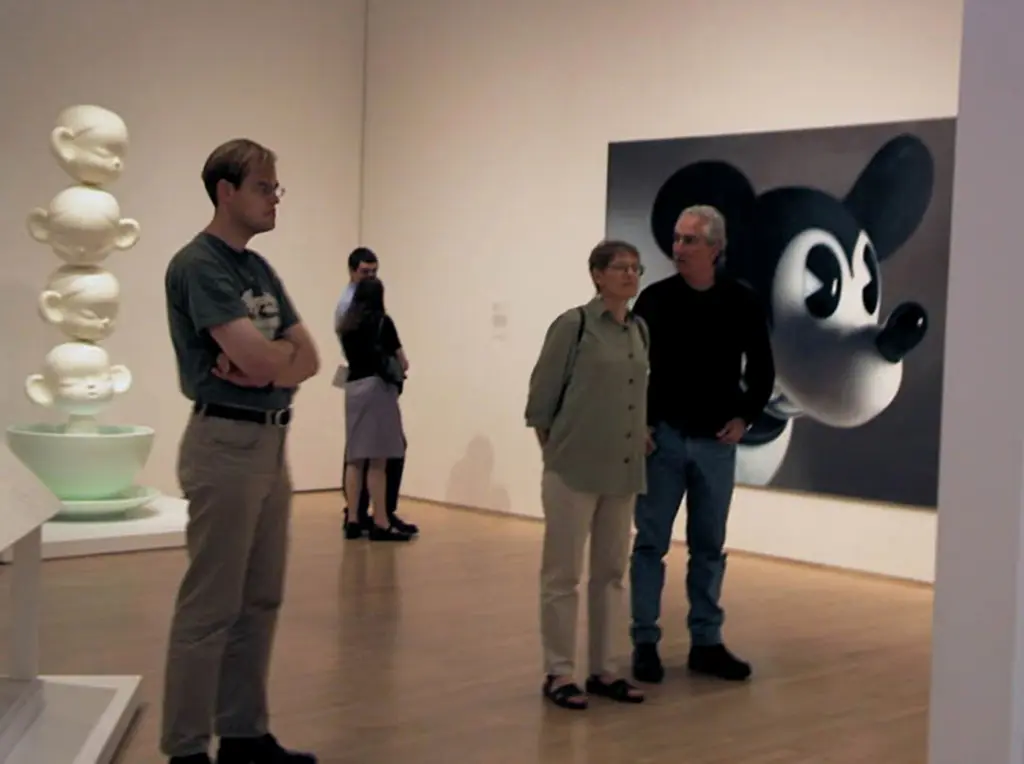
...Murakami is a Japanese-born artist who spends half his time in New York. Animation and comic books have influenced his life and work. Murakami's DOB is a copyrighted image of a white-gloved mouse-eared figure who seems to have come under the spell of Mickey and been Mickeyfied. Even more interesting are the swirling fanciful fungi that surround this Mickeyfied image. These psychedelic fungi are reminiscent of the dancing mushrooms from Disney's Fantasia. Murakami's work playfully alludes to Disney im-ages, whereas Helnwein's are appropriated. Helnwein and Murakami both have a photographic painting style. Pensato employees an expressionistic painterly one, but stays within a black and white palette. Over the last ten years, Pensato has executed many images of Mickey Mouse but the image in the exhibition in San Francisco was of Minnie, a rarity from any artist.
THE WORK
[Chapter 7, Portraits and the Mickeyfied, pages 156-163]
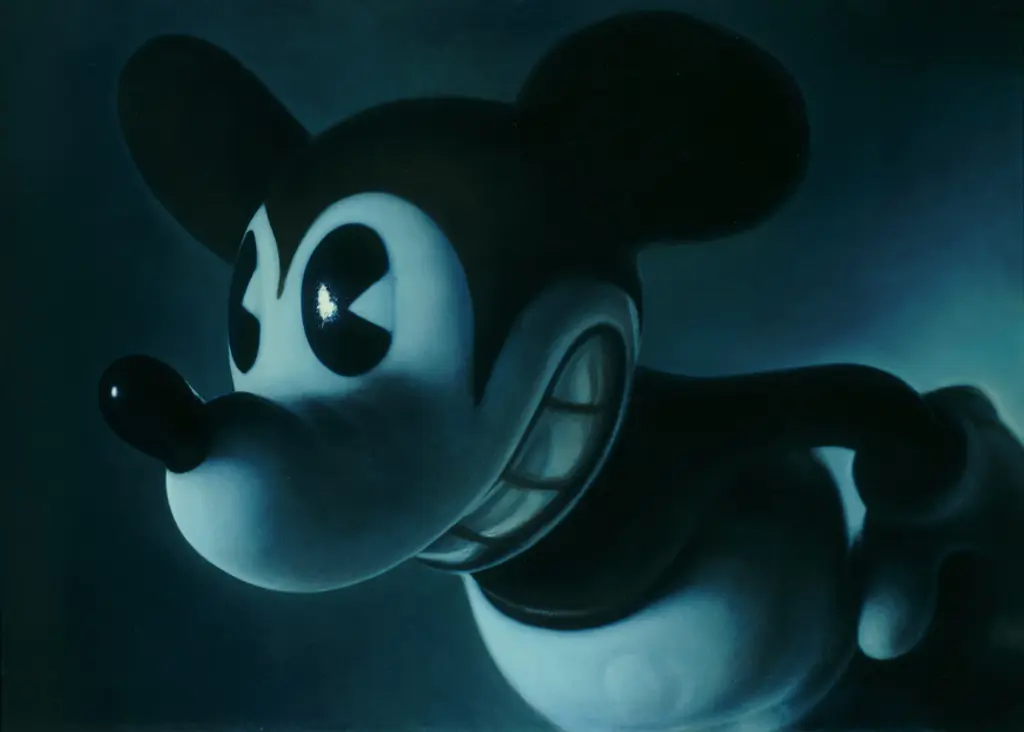
Helnwein's portrait of Mickey refers to this understanding while suggesting a different personality. Mickey's head fills the picture frame; he is large, toothy, and grinning unpleasantly as he pushes out into your space. One writer thought the Mouse "stares back at us." He does not. The Mouse is special, a star. He seems to preside over the space while avoiding eye contact. This Mouse is not trying to please you and win you over; he bares his teeth as he leans obliquely forward, moving from an unseen space. "He is at once, both benignly sweet and threateningly sinister depending on your age and viewpoint." I found his gaze to be threatening as though he just might eat you; he gazes intensely into your realm as he leans forward from above you, moving into your space. Helnwein's image of the Mouse "hovers between carefree and carnivorous." This Mouse does not eat flesh, but you would still not want this Mouse to take any notice of you. "It is the unease of our age that Helnwein has seized upon." This is not the unease that might have been felt by a peasant as the king rode by high on his horse surveying his lands. In "our age," the unease is elicited by a cartoon character created by a corporation that wants a paying non-critical audience that dreams his dream. The king is dead; long live the king!
Disney presented a similarly large and somewhat threatening Mickey in the form of a balloon in the Macy's Thanksgiving Day Parade. Helnwein's com-position of the Mouse is also reminiscent of current public events—political and corporate—where the speaker is projected on a large screen above the au-dience. Helnwein and Disney both portray Mickey as a spectacle. Mickey was once a scrappy regular guy; he is now larger than life, looming above everyone else—a threatening image. One reviewer thought Helnwein's Mickey looked, "sneaky and suspicious. His broad smile, encasing a row of gleaming teeth, seems more a snarl or leer. This is Mickey as Mr. Hyde, his hidden other self now disturbingly revealed."
Reviews
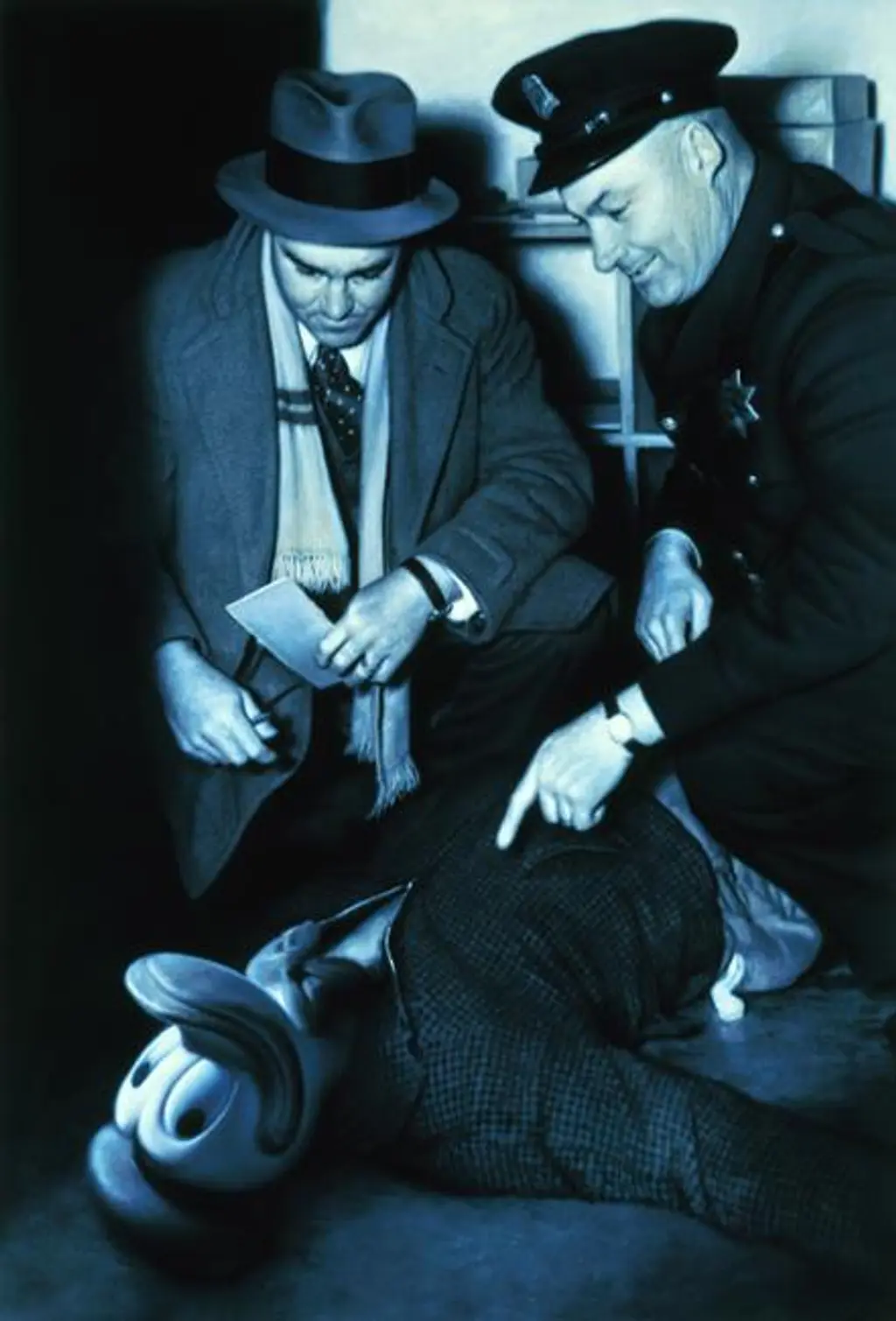
"In her innovative book Attached to the Mouse Holly Crawford examines the appropriation of the iconic images of Mickey Mouse and Donald Duck with thoughful scholarship and spirited humor."--Peter Selz, Professor Emeritus, History of Art, UC Berkeley.
"Enjoyable, brilliant, readable, and enormously informative. The seminal study of how mass media institutions—Disney and Art—function in our culture, written with flashes of humour. It’s likely to be a premier resource for years to come." --Professor Manuel Alvarado, Arts & Media, City University, London, UK
"For at least a half-century Mickey Mouse, ears and all, has served as one of the most potent icons in contemporary visual culture. The poster boy for everything from cinematic innovation to American cultural 'imperialism,' the animated rodent is freighted with a veritable encyclopedia of inference. Not surprisingly, artists the world over -- and especially Mickey's countrymen and -women -- have fixated on the simply, distinctively drawn figure. But however much that (deceptively) ingenuous face and unique silhouette turn up in Pop paintings, social-commentary cartoons, and even abstract sculpture, writers and historians have let Mickey's ubiquity pass without substantial comment. Until now. Defying the perils of post-modernist close reading, pop-culture fetishism, and the fabled wrath of Disney Corp., Holly Crawford proffers an exhaustive documentation, classification, and analysis of Mickey's many appearances in the visual art of our time. Her study fills a gap in the critical history of recent art, not to mention in Mouseology."
—Peter Frank, Critic and Curator
Imprint:
Copyright 2006 by Holly Crawford
University Press of America, Inc.
4501 Forbes Boulevard
Suite 200
Lanham, Maryland 20706
UPA Acquisitions Department (301) 459-3366
PO Box 317
Oxford
OX2 9RU, UK
All rights reserved
Printed in the United States of America
British Library Cataloging in Publication Information Available
Library of Congress Control Number: 2006924063
ISBN 13: 978-0-7618-3474-8 (paperback : alk. ppr.)
ISBN 10: 0-7618-3474-5 (paperback : alk. ppr.)