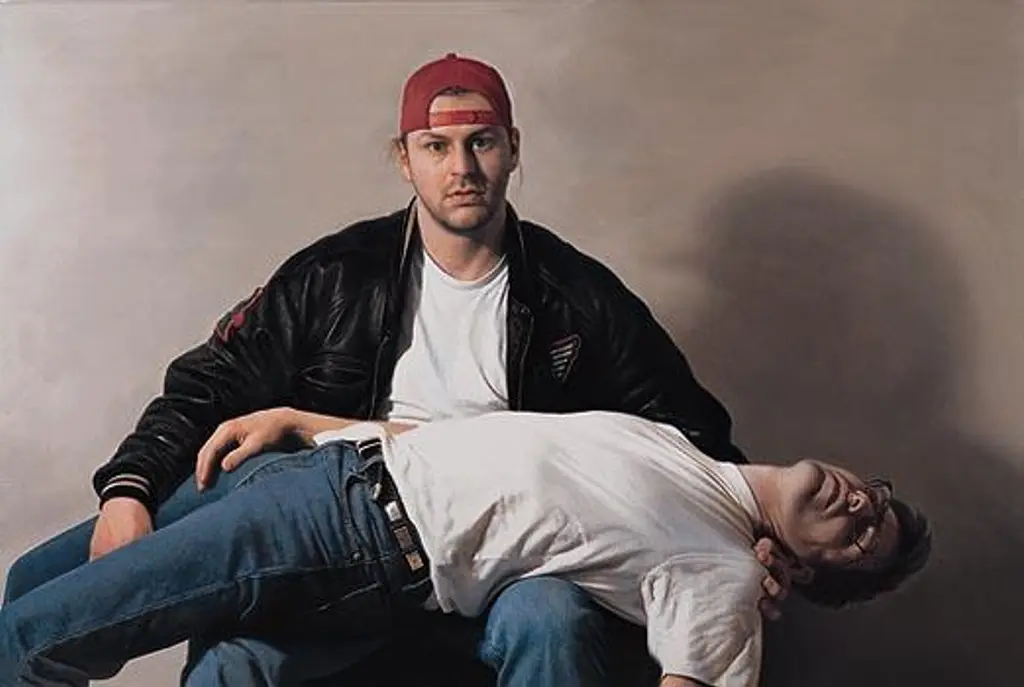
Helnwein’s Pietà is very different from the usual portrayal of Mary holding the body of Jesus as depicted by artists such as Michelangelo. Helnwein uses the posture of the typical pietà, but with the figures of Mary and Jesus replaced by a father and his son, which questions the archetypal Christian symbolism by the use of homo-erotic connotations.
One of the main themes of Helnwein’s art is shown in the piece MacBeth from 1987. Here, he tries to capture an everyday news story and the overall journalistic aesthetic. Helnwein tries to make these stories stick in his viewer’s mind, so that turning a blind eye becomes impossible as he moves beyond the realm of pure aesthetics, engaging his art with the everyday world.
Another painting dealing with the same issues is Der Schrei from 1989, which is a reformulation of Edward Munch’s famous The Scream. The issue at hand here also deals with blind society and a cry for the spectators to open their eyes to what is really going on around them and, as in Munch’s painting, there is a feeling of both loneliness and madness in Der Schrei.
At first glance, Helnwein’s works can seem fun in their play with traditions of art history and modern figures, which in turn play with the viewer’s expectations, but they soon open up to multiple layers and interpretations. As you take a closer look, the paintings go from a fun play on traditions, to a darker satirical wake up call, to an audience who expects only to be entertained. In this way, Helnwein captures his spectator and forces him to look reality in the eye if only for a little while before turning to the next page.