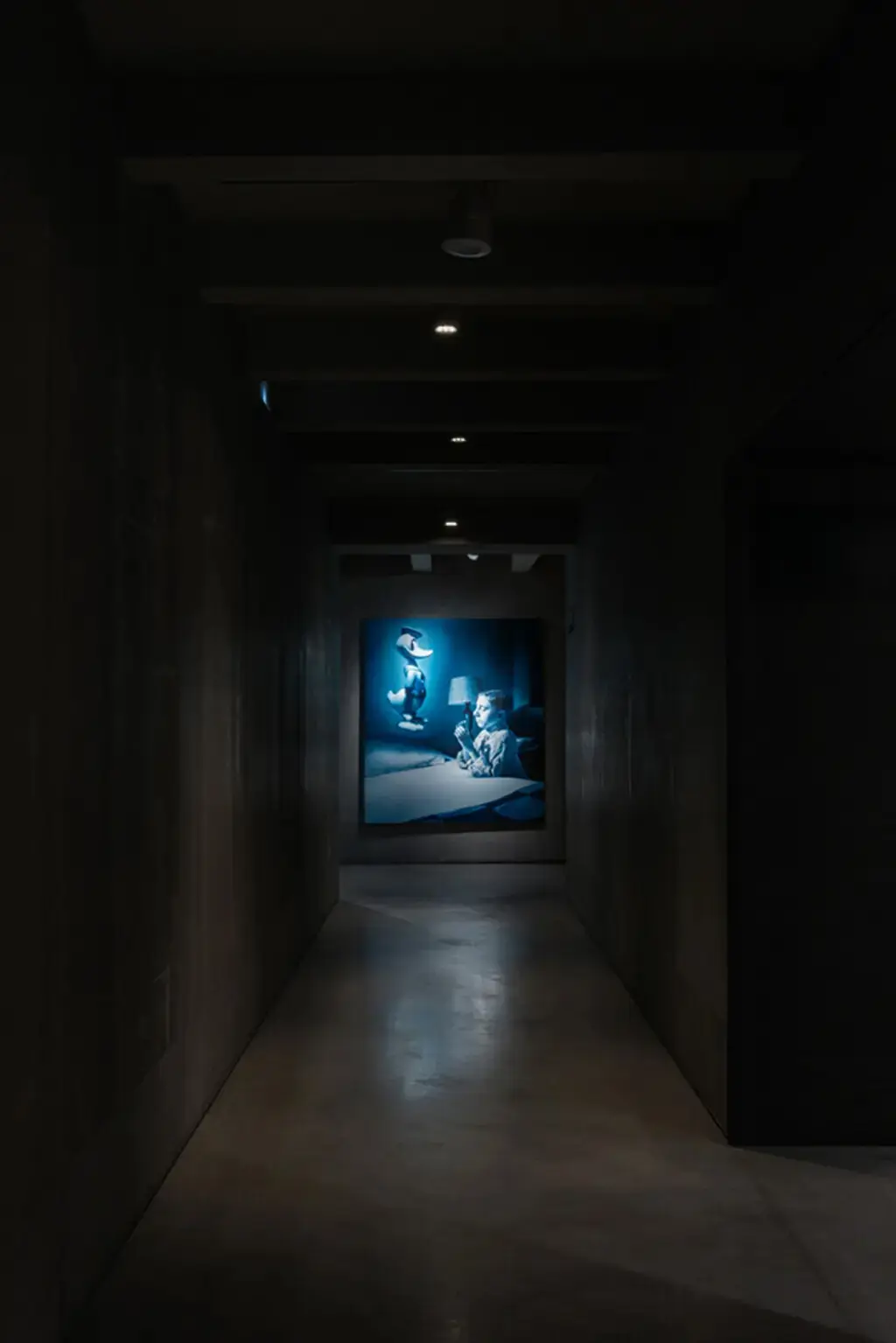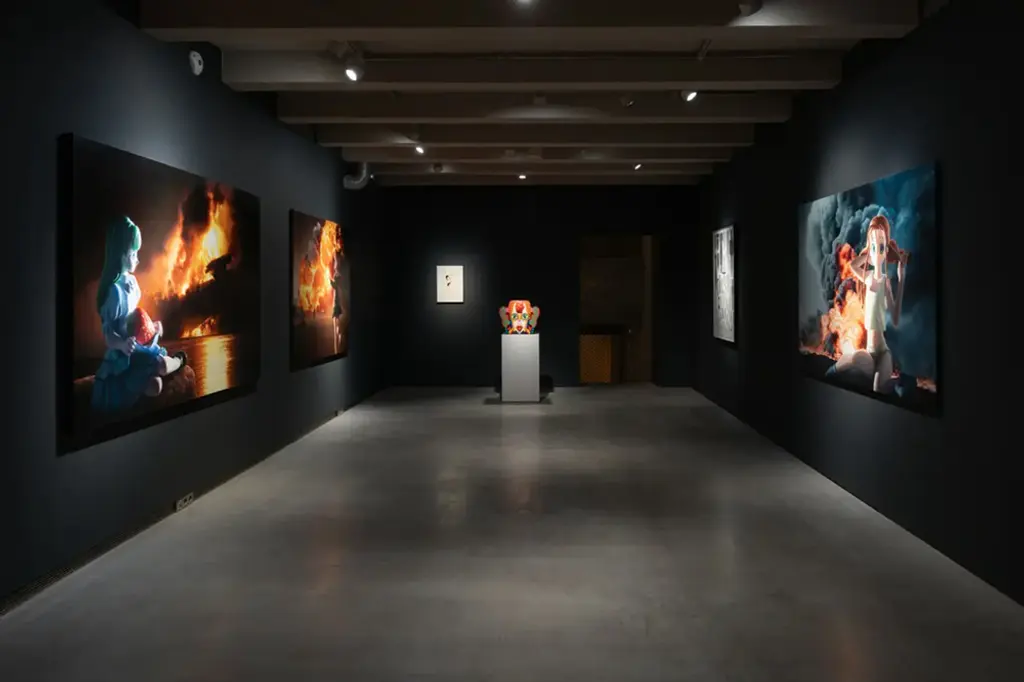
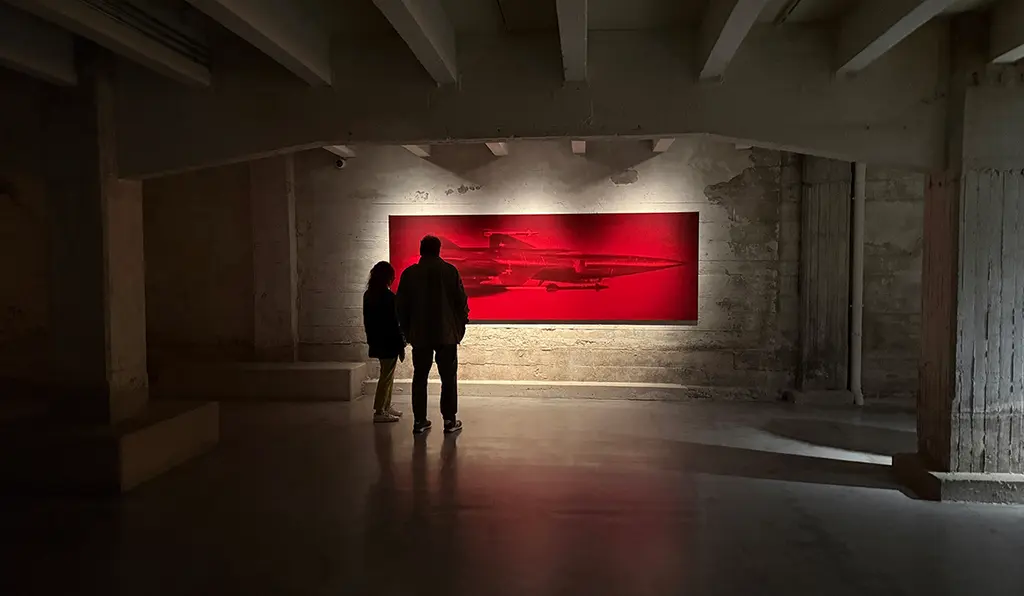
His paintings linger between pop-cultural symbols and issues around power, conflict and trauma. His artistic practice began in the 1960s, including performance and activism. He became known for his hyperrealism, which, encountered now in a time shaped by AI, reads quite differently, as a quiet doubt lingers: is it real? And I find myself compelled by this tension more so than by the unsettling subject matter itself. There is no glitch, no rupture to release the viewer into certainty. Instead, one remains suspended on the immaculate surface, caught between intrigue and horror, with no safe distance from which to breathe. What remains, then, is the process: the method, the discipline, the physical labour embedded in each work. A respect emerges – for skill, for endurance, for the sheer insistence on painting.
Across decades, Helnwein uses recurring protagonists: Donald Duck, Adolf Hitler and the child. Together, they form a constellation of images that feel at once glorified and deeply fractured. His visual language is strikingly consistent, a chronology of obsessions threading through his life and practice – visible even in the structure of his own website–cum–archive.
Within this continuum, there is an influence of Francisco de Goya, the Spanish painter who rendered the grotesque and deeply human realities of war with unflinching clarity, particularly in The Disasters of War, which Helnwein has revisited in his work. But, Helnwein does not recreate history; he absorbs its visual gravity. Drawing from historical documents, but also from contemporary manga, cinema and video game aesthetics, he constructs scenes that articulate the ongoing structural, endemic violence.
This absorption finds one of its most persistent expressions in the tension between childhood and horror. Helnwein repeatedly returns to the memory of encountering Donald Duck – a formative moment, a portal into another world during a bleak post-war upbringing in Vienna. It was a world still grappling with the aftermath of unspeakable violence, and although it makes sense that, in this context, this American comic figure arrives as a kind of antidote, and one can comprehend the artist’s impetus, the collision is difficult to reconcile: a six-year-old’s memory of ‘colour and hope’ set against the figure of absolute monstrosity. It raises questions about the burden of not letting go, of returning again and again to the same symbols of identity-defining force.
What strikes me when walking through the exhibition is that, although Helnwein describes this early encounter as a revelation – a return to light, to a world where violence is reversible and harm leaves no trace – Donald Duck in these works rarely seems liberating. He often lingers – passive, sometimes ominous – and the promise never fully holds; the tension between cartoon logic and historical reality remains unresolved.
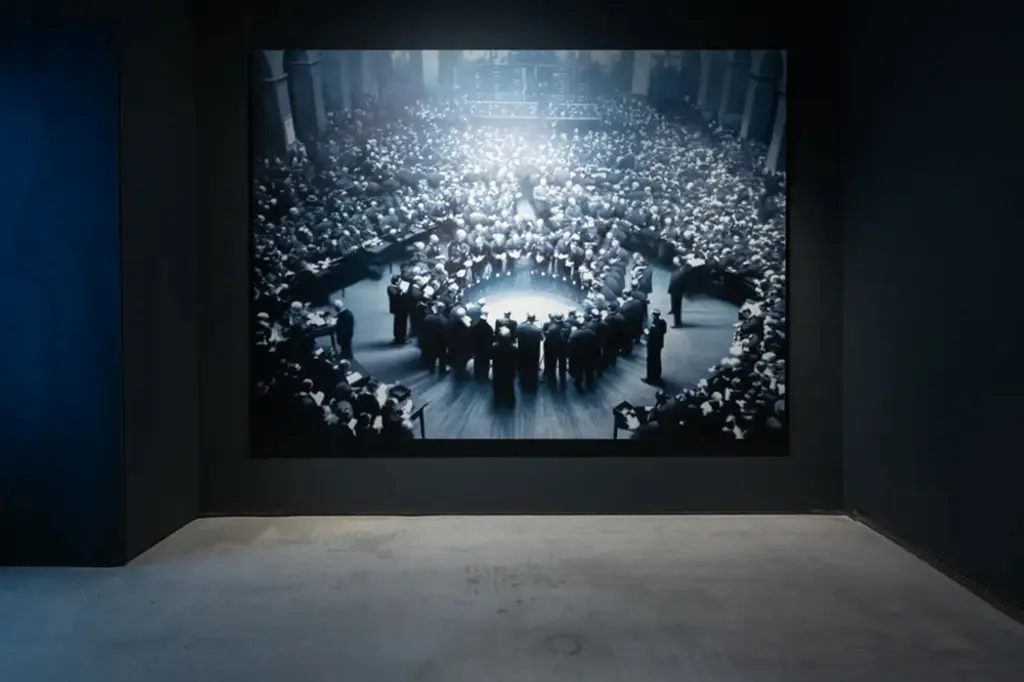
The child appears as another important figure throughout, recurring not as an individual but as a surrogate – a figure that carries the weight of betrayal and vulnerability, one human being at the mercy of another. Alongside this, weapons, military uniforms and suits appear repeatedly, signalling how power is staged, performed and maintained. There is a pivotal moment in the exhibition – The Meeting II (1996), a painting that depicts a room full of suited men gathered around a glowing centre, a composition that feels newly resonant with the fight for supremacy of today. It is here that Helnwein’s imagery sharpens again, where past and present collapse into a single, recognisable structure of control – and perhaps a dark harbinger of repetition: ‘I believe it is the artist’s responsibility to be a witness of his time, to capture this madness, and prevent people from forgetting.’ – Gottfried Helnwein
Further into the exhibition, we encounter not only Helnwein’s works but also 30 international artists who enter into a dialogue with him. These works span a spectrum between contemporary fine art traditions and visual culture–driven practices, with strong roots in surrealism, figuration and pop aesthetics. Across these practices, recurring concerns include identity, transformation, memory and the subconscious, often expressed through distorted figuration or materially experimental sculpture. The result is an expansive curatorial strategy: one central voice in conversation with many different materials, accounts, times and places.
In a similar way of expanding spaces and ideas, SOLO defines itself as an international arts project dedicated to fostering, supporting and sharing the art of today. Founded in 2015 by Spanish entrepreneurs Ana Gervás and David Cantolla, its mission is ‘to cultivate an ecosystem that fosters artistic dialogue and engages a global, diverse audience across both physical and digital platforms’.
Maybe it is, similar to the exhibition’s title – mundos invertidos – a space that leaves room for interpretation and multiplicity without giving clear instructions on how to use it or how to read the art presented, but, as Helnwein has practised it, as a dedication, a craft and an ongoing conversation.